Can vibe coding replace Salesforce?
For most SMBs, yes — vibe coding tools allow non-developers to build custom CRM systems in days that would take months and six figures to implement in Salesforce. The replacement is already happening quietly through non-renewals, not announcements.
Vibe Coding Replace Salesforce: Why the $300B CRM Is Losing
Salesforce Is a $300 Billion House of Cards. Vibe Coding Is the Wind.
By a practitioner who’s been watching enterprise software bloat since 2019 — and building the replacements since 2024.

The Elephant Nobody Is Naming
Let me say it plainly, the way nobody at a Dreamforce keynote ever will:
Salesforce is not a product. It is a hostage situation.
You didn’t buy CRM software. You bought 18 months of implementation, a $400/hour SI partner, a team of “Salesforce admins” who gate-keep button clicks, and a license renewal conversation that feels like a ransom note.
And for 25 years, you paid it. Because you had no choice.
That era ended sometime in 2024. Most people just haven’t noticed yet.
What Vibe Coding Actually Is (Not the Meme Version)
The internet decided “vibe coding” means typing “make me an app lol” and shipping broken garbage. That’s the strawman. Ignore it.
What vibe coding actually is — in the hands of someone who’s done it across 40+ projects — is intent-first software development. You describe what the business needs, not how the database should be structured. The AI handles the translation layer. You stay at the level of outcomes.
This is not junior dev with autocomplete. This is a senior product thinker with a full-stack execution engine in the passenger seat.
The skill isn’t prompting. The skill is knowing exactly what you want — which, ironically, is the same skill that makes a great Salesforce architect. Except now, instead of configuring someone else’s opinionated system, you’re building your own.
Why Salesforce Was Always Vulnerable
Salesforce’s core bet was: software is too hard for most companies to build, so buy ours.
That bet had three load-bearing assumptions:
1. Custom software takes too long. A Salesforce org can be live in weeks. A custom CRM used to take 18 months. That delta was Salesforce’s moat.
2. You need specialists to maintain it. Salesforce admins, developers, architects — a whole ecosystem of people whose job was to operate the complexity Salesforce created.
3. The data gravity is too high to escape. Once your 10 years of customer history, pipeline data, and workflow automations live in Salesforce, leaving costs more than staying.
Vibe coding is dismantling all three — simultaneously.
The Speed Argument Is Already Over
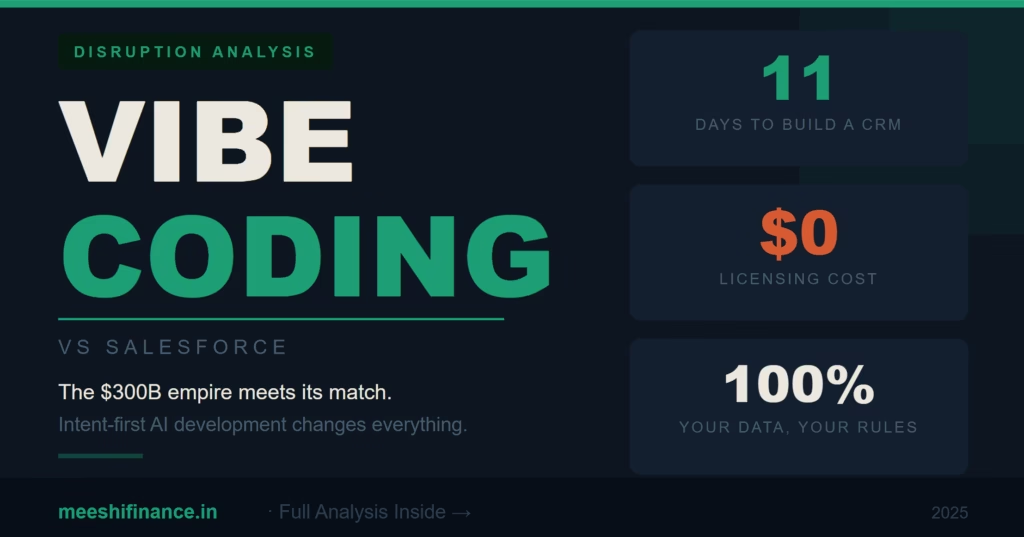
I rebuilt a lead management + pipeline tracking system last month. React frontend, Supabase backend, Claude AI embedded for natural language task creation. Took 11 days working part-time.
Comparable Salesforce Sales Cloud implementation? Minimum 6 weeks with a partner. More likely 4 months. And that’s before customization.
The gap isn’t closing. It has inverted. Custom is now faster than configured, because configuration at Salesforce’s complexity level is itself a form of programming — just a worse one, trapped inside someone else’s UX.
When I say 11 days, I don’t mean a toy. I mean:
- Role-based access control
- Pipeline stages with probability weighting
- Activity logging
- Email notification hooks
- Mobile-responsive UI
- AI that takes plain-English instructions and converts them to task updates
This is not a demo. This is production software. And it cost me compute credits, not a six-figure contract.
The Specialist Moat Is Dissolving
The Salesforce ecosystem employs hundreds of thousands of admins, devs, and consultants. Their value proposition is: you need us to operate this machine.
Vibe coding’s value proposition is: the person who understands the business should be building the software.
When a founder can describe their sales process in natural language and have a working CRM in two weeks — they don’t need an admin. They need someone who understands their business. That person is often already on payroll.
I’m not saying developer jobs disappear. I’m saying the jobs that exist purely to translate business needs into Salesforce config — those are the jobs that evaporate. And that translation layer was Salesforce’s competitive moat.
The Migration Problem Is Smaller Than You Think
“But our data—” I know. I hear this every time.
Here’s the thing: Salesforce’s data lock-in is psychological more than technical. Salesforce exports to CSV. Supabase imports CSV. Postgres handles your entire 10-year CRM history in an afternoon. This is a solved problem.
The real lock-in is workflow familiarity. Your team knows where to click. That’s real friction. But it’s 90-day friction, not 10-year friction. And when you replace it with software built specifically around how your team actually works — not how Salesforce thinks sales teams should work — adoption tends to surprise you.
What Vibe Coding Cannot (Yet) Do
I will not oversell this. Intellectual honesty matters.
Enterprise compliance: HIPAA, SOC 2, GDPR audit trails — these require deliberate architecture, not vibes. Achievable, but not automatic.
Legacy integration depth: If you’re deep in a Salesforce + SAP + Workday hairball, untangling that requires systems thinking that no AI can shortcut.
Org-scale governance: 5,000-person orgs with 300 custom objects and decade-old automation chains — those are archaeological digs, not sprints.
But here’s what’s important: Salesforce was never the right answer for 80% of its customers. Most companies buying Sales Cloud or Service Cloud are $5M–$500M businesses with relatively simple needs that got sold complexity they didn’t need.
Those companies are vibe coding’s first market. And it’s enormous.
The Pattern I Keep Seeing
I’ve watched this happen across dozens of conversations in the last year:
A founder or ops lead — usually someone technically curious but not a traditional dev — gets frustrated with Salesforce’s rigidity. They try a vibe coding tool. They build something small. It works better than they expected. They build something bigger. Then they quietly start moving things over.
They don’t announce a “Salesforce replacement initiative.” They just stop using Salesforce for the new stuff. Then the old stuff migrates because everyone prefers the new thing. Then the renewal comes up and the CFO asks why they’re paying $180K/year for a system 40% of the team uses.
It doesn’t end with a bang. It ends with a non-renewal email.
The Actual Thesis
Salesforce built a business on complexity arbitrage — the gap between what businesses need and what they could build themselves. That gap was real for 25 years.
Vibe coding collapses that gap.
Not completely. Not overnight. Not for every use case. But enough — for enough customers — that the next 10 years look nothing like the last 10.
The companies that figure this out first won’t just save on software costs. They’ll have CRM systems that actually match their sales motion, not a generic template they’ve been contorting themselves into. They’ll ship changes in hours, not tickets. They’ll own their data, their schema, their logic.
That’s not a feature. That’s a different relationship with software entirely.
And once you’ve experienced that, you don’t go back.
The author has been building production software with AI-assisted development since early 2024, across SaaS tooling, financial advisory automation, and internal ops systems. None of it required a $400/hour implementation partner.